

HOFMEISTER,FRIEDRICH - 1068040
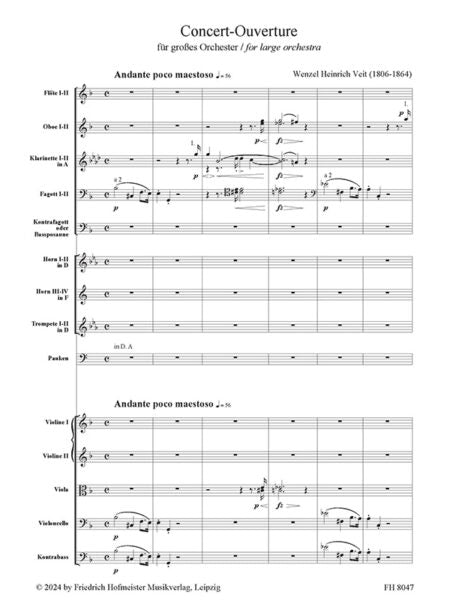
Veit: Concert Overture for Large Orchestra, Op. 17 (Full Score)
- Composer: Wenzel Heinrich Veit
- Publisher: Friedrich Hofmeister Musikverlag
Choose options
The Concert Overture Op. 17 presents an instrumentation adapted to the musical requirements of Romanticism, giving the wind instruments a new significance.
It begins with an Andante poco maestoso in 4/4 time with various dialogic interjections from the woodwinds, followed by soloistic entries accompanied by melodic interplay. All of this leads to an Allegro molto in 2/4 time with dizzying rhythms, pizzicati in the strings, and staccati in the woodwinds building to fortissimo, with several instruments doubling the main theme of this Allegro in addition to brilliant orchestration. This is followed by a section where the figurations become longer and the tempo drops into a minor key, then returns to a major key with a melody and more lively rhythms. It continues in this manner, alternating between melody and more animated rhythms, until a passage in minor is heard. Gradually, a section of ostinati is reached in which the tension rapidly increases until it achieves the fortissimo of the Allegro's main theme. Then the rhythm falls to piano with half notes into a melodic zone, though it gradually increases in tension and intensity until reaching the Poco più moto. This signals the final section, in which accompanied melody, chords, and ostinati herald the end of the work.
The Concert Overture Op. 17 is inspired by several lines from the poem Oberon by the poet Christoph Martin Wieland (Canto VII).