
OXFORD UNIVERSITY PRESS - 19
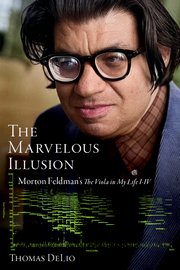
The Marvelous Illusion Morton Feldman's The Viola in My Life I-IV
Author: Thomas DeLio
Publisher: Oxford University Press
The Marvelous Illusion Morton Feldman's The Viola in My Life I-IV
Juilliard Store
144 West 66th Street
New York NY 10023
United States
Choose options
The Marvelous Illusion Morton Feldman's The Viola in My Life I-IV
Juilliard Store
144 West 66th Street
New York NY 10023
United States
The Marvelous Illusion Morton Feldman's The Viola in My Life I-IV
Juilliard Store
144 West 66th Street
New York NY 10023
United States
Thomas DeLio
The Marvelous Illusion: The Viola in My Life I-IV is a detailed analytical study of four of Morton Feldman's most important works. Morton Feldman was one of the most original composers of the 20th century, and throughout his career he attempted to locate sound at the moment the listener becomes conscious of its presence. Focusing on the listener's attention on the sounds themselves, Feldman created the "marvelous illusion" of sounds shaping into coherent music through the act of perceiving them, rather than through the act of composing. Each work appears to assemble itself for the listener as they experience it.
Author Thomas DeLio examines each work from the perspective of pitch/interval content, temporal evolution, register and timbre. Spectrographs are used to visualize what a listener actually hears, not just what is notated on a printed page, offering a window into dimensions of sound that clearly, deeply affect our experience of a musical work but which are typically not considered when analyzing music through traditional means. This perspective prioritizes timbre as central to the creative impulses of Feldman's work.
This book frames these analyses with a discussion of Feldman's relationships to important contemporaries in other arts. Feldman was one member of the so-called New York School of composers which also included John Cage, Christian Wolff, and Earle Brown. He was also connected to painters, writers, and poets of the New York School as well, including Mark Rothko, Philip Guston and Franz Kline, Jasper Johns, Robert Rauschenberg, and notably Frank O'Hara. DeLio takes the specific analytical details of Feldman's compositions and fashions a tapestry of interconnections and context to reveal that above all Morton Feldman's music is about sound and spontaneity, connections arising for the listener as the composition is heard.