

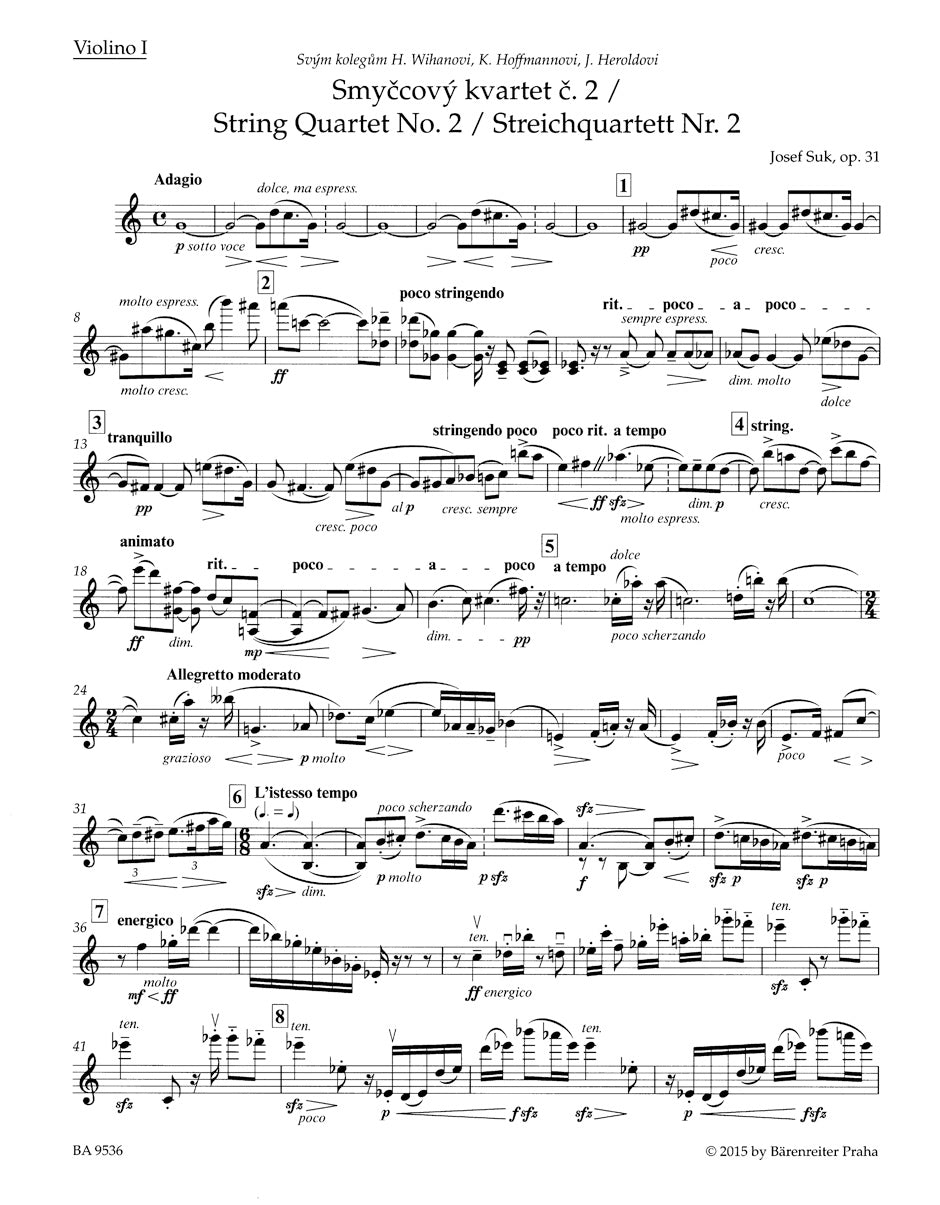
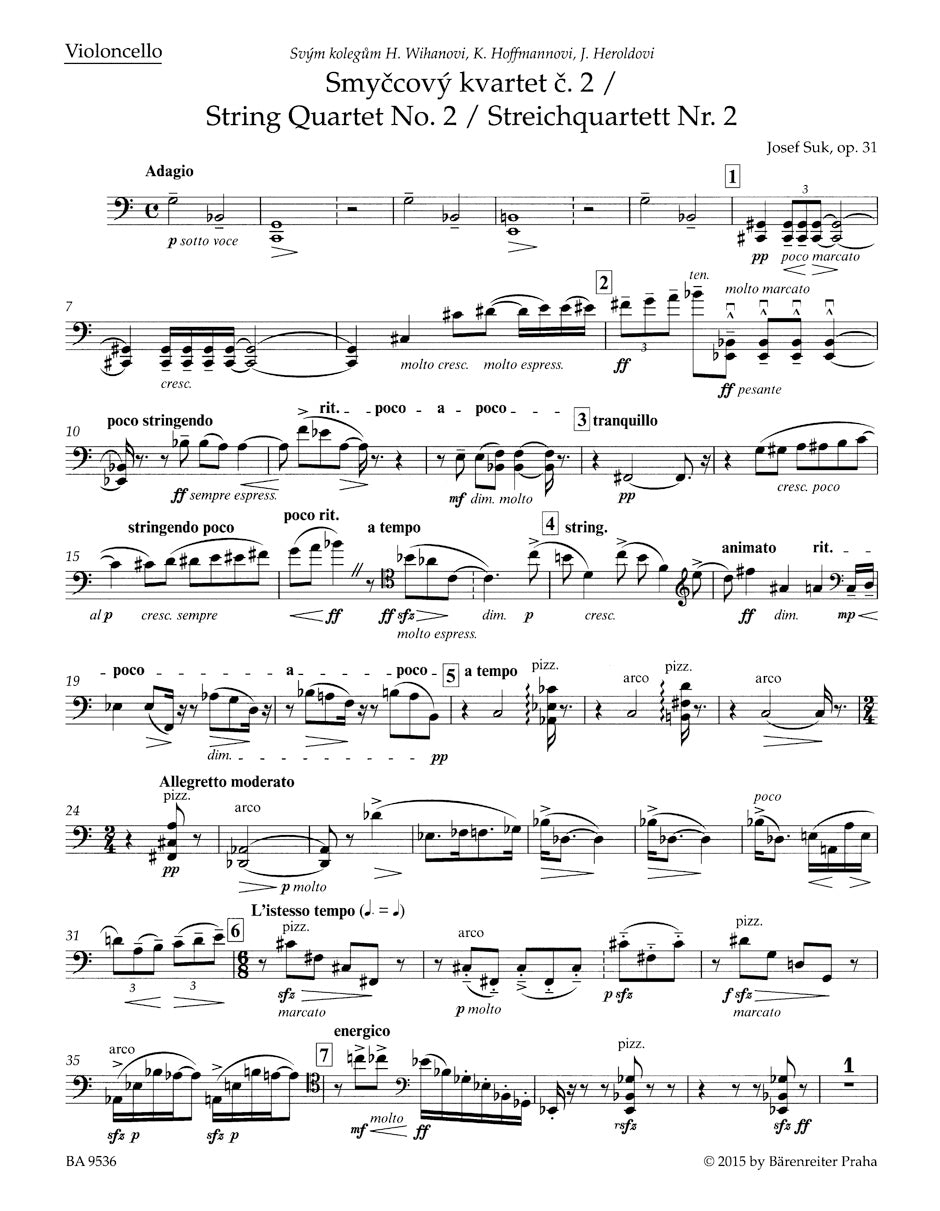
BARENREITER - 345062
Suk String Quartet No 2 Opus 31
Quantity:
Pickup available at Juilliard Store
- Composer: Josef Suk
- Publisher: Bärenreiter
- Instrumentation: Violin I, Violin II, Viola, Cello
- Format: Chamber Parts
- Binding: Folder
- Dimensions: 12.2 in x 9.6 in
- Pages: 17/16/19/15
Choose options
Quantity:
Pickup available at Juilliard Store
Quantity:
Pickup available at Juilliard Store
Editor: Nouza, Zdenek
Orchestral scoring : 2V/Va/Vc
Product format: set of parts, Urtext edition
Binding: in a folder
Pages / Format: 17/16/19/15 - 31,0 x 24,3 cm
First scholarly-critical edition
The single-movement String Quartet No. 2 by Josef Suk (1874–1935) was written at the height of his compositional powers. Completed in Krecovice in May 1911, this demanding work, with its complex harmonies and motivic structure, seemed avant-garde for its day: the Berlin premiere of November 1912 was accompanied by protests from the audience.
Now Zdenek Nouza has edited the first scholarly-critical edition of this piece. The principal source is the first edition in full score, published by Simrock in Berlin. But Nouza has also consulted the printed parts (containing additions of great interest to performers) as well as the engraver’s copy used for the printed score (with autograph corrections from the composer) and additional sources such as sketches.
• First Urtext edition
• Foreword (Cz/Ger/Eng) and Critical Commentary (Eng) by the editor
The single-movement String Quartet No. 2 by Josef Suk (1874–1935) was written at the height of his compositional powers. Completed in Krecovice in May 1911, this demanding work, with its complex harmonies and motivic structure, seemed avant-garde for its day: the Berlin premiere of November 1912 was accompanied by protests from the audience.
Now Zdenek Nouza has edited the first scholarly-critical edition of this piece. The principal source is the first edition in full score, published by Simrock in Berlin. But Nouza has also consulted the printed parts (containing additions of great interest to performers) as well as the engraver’s copy used for the printed score (with autograph corrections from the composer) and additional sources such as sketches.
• First Urtext edition
• Foreword (Cz/Ger/Eng) and Critical Commentary (Eng) by the editor