
BARENREITER - 345062
Schubert Lieder, Volume 6 (Medium Voice)
CURTAIN CALL · 20% OFF
This copy has spent time on our shelves and may show light wear, such as minor scuffs, bent corners or fading. Discount applied at checkout. All Curtain Call sales are final.
See all Curtain Call- Composer: Franz Schubert
- Publisher: Bärenreiter
- Instrumentation: Voice
- Binding: Paperback
- Dimensions: 11.8 in x 9.1 in
- Pages: 159
Choose options
CURTAIN CALL · 20% OFF
This copy has spent time on our shelves and may show light wear, such as minor scuffs, bent corners or fading. Discount applied at checkout. All Curtain Call sales are final.
See all Curtain CallCURTAIN CALL · 20% OFF
This copy has spent time on our shelves and may show light wear, such as minor scuffs, bent corners or fading. Discount applied at checkout. All Curtain Call sales are final.
See all Curtain CallEditor: Dürr, Walther
Orchestral scoring : mivoice/piano
Language(s) of work: D
Language(s) of text: D
Product format: singing score, Anthology, Urtext edition
Binding: Paperback
Pages / Format: XLII, 159 - 30,0 x 23,0 cm
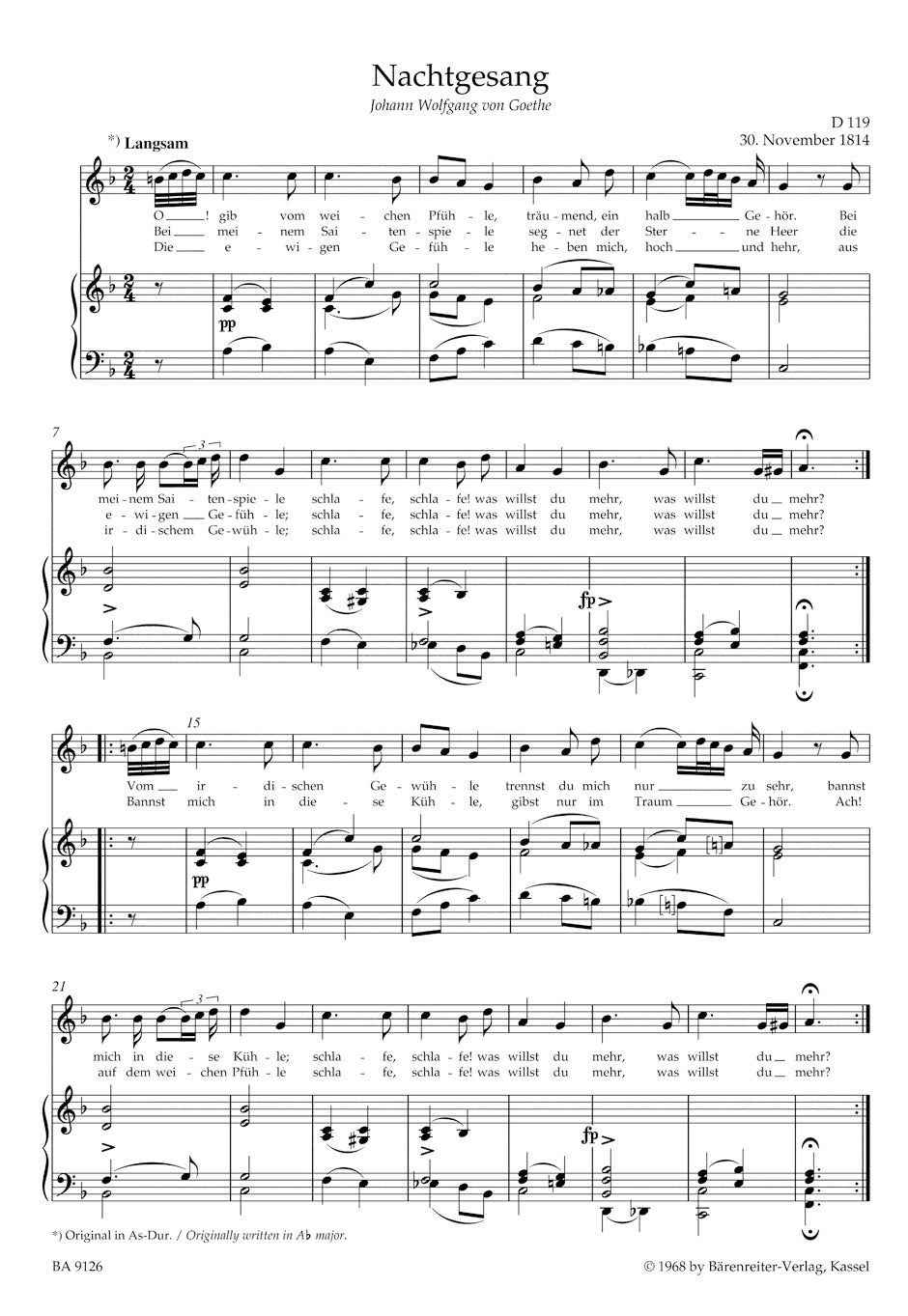
The lieder in this sixth volume were composed during the period between autumn 1814 and spring 1815. With “Nachtgesang” (D 119) and “Trost in Tränen” (D120) Schubert turns to the “Strophenlied” in its stricter sense for the first time. He develops an interest in this form parallel to his first involvement with Geothe. Schubert, during this period an assistant teacher at his father’s school, orientated himself towards the so-called “Berliner Liederschule”, particularly the songs of Johann Friedrich Reichardt. By the beginning of the year 1815 he drew his inspiration mainly from the texts of Theodor Körner; however he regularly still produced settings for the poetry of Goethe and Schiller.
- Based on the Urtext of the “New Schubert Edition”
- Newly engraved, clearly presented musical layout
- Foreword by Walther Dürr on the history and genesis of the work as well as an explanation of the sources for each individual lied (Eng/Ger)
- Includes English translations of lieder texts by Richard Wigmore
Contents
“Nachtgesang”, D 119
“Trost in Tränen”, D 120 / “Ammenlied”, D 122
“Sehnsucht”, D 123 / “Am See”, D 124
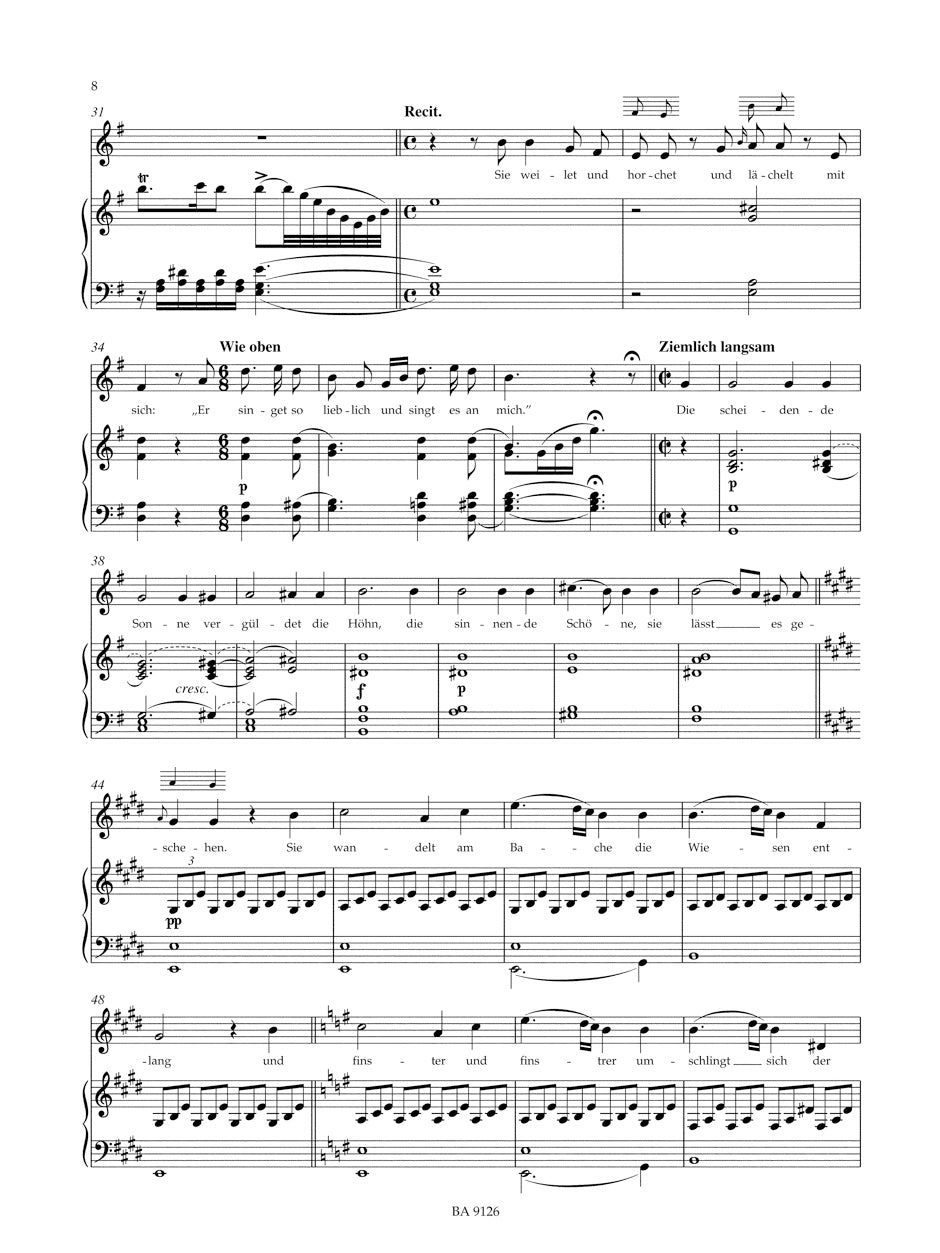
“Szene aus ‘Faust’”, D 126 (2nd version)
“Ballade” op. 126, D 134 / “Klage um Ali Bey”, D 496A
“Der Mondabend” op. post. 131, 1, D 141
“Genügsamkeit” op. post. 109,2, D 143
“Der Sänger” op. post. 117, D 149 (2nd version)
“Lodas Gespenst”, D 150
“Auf einen Kirchhof”, D 151 / “Minona”, D 152
“Als ich sie erröten sah”, D 153 / “Das Bild” op. post. 165,3, D 155
“Die Erwartung” op. post. 116, D 159 (2nd version)
“Don Gayseros”, D 93
“Sängers Morgenlied”, D 163 (1st setting)
“Sängers Morgenlied”, D 165 (2nd setting)
“Amphiaraos”, D 166
“Gebet während der Schlacht”, D 171 (1st version)
“Das war ich”, D 174 / “Die Sterne”, D 176
“Vergebliche Liebe”, op. post. 173, 3 / D 177
“Liebesrausch”, D 179 / “Sehnsucht der Liebe”, D 180
Appendix I
“Szene aus ‘Faust’”, D 126 (1. version) / “Der Sänger”, D 149 (1st version)
“Die Erwartung”, D 159 (1. version) / “Gebet während der Schlacht”, D 171 (2nd version)
Appendix II (lower transposition only available for high voice)
“Am See”, D 124