
INGRAM BOOK COMPANY - 001-100058
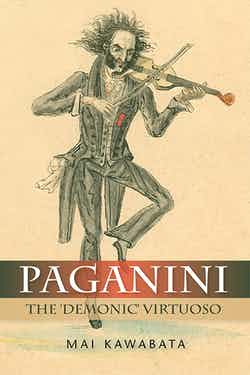
Paganini The Demonic Virtuoso
Quantity:
Pickup available at Juilliard Store
- Author: Mai Kawabata
- Publisher: Boydell Press
Choose options
Quantity:
Pickup available at Juilliard Store
Quantity:
Pickup available at Juilliard Store
Separating fact from fiction, this book explores how the legendary violinist challenged the very notion of what it meant to be a musician.
Our inherited image of Nicolo Paganini as a 'demonic violinist' has never been analyzed in depth. What really made him 'demonic'? This book investigates the legend of Paganini. Separating fact from fiction, it explains how the virtuoso violinist challenged the very notion of what it meant to be a musician.
Mai Kawabata considers Paganini's performance innovations, violin techniques and musical ethos in the light of contemporary attitudes towards music and the supernatural, gender, sexuality, violence, heroism and masculinity as well as conceptions of power. The many perceptions of Paganini as demonic - Faust, magician, devil, rake/libertine, Napoleon - were inter-related but not equivalent. A swirl of cultural factors coalesced in the performer to create that phenomenon of Romanticism, a larger-than-life Gothic villain. Kawabata shows how the idea of virtuosity spiraled out of control, acquiring a potent, overwhelmingly negative aura in the process, as the mythology surrounding Paganini outlived and outgrew the man to monstrous proportions. An appendix brings together late nineteenth-century British press and literature coverage of Paganini that contributed to the developing myth surrounding the now famous composer and performer.
MAI KAWABATA is Lecturer in Music at the University of East Anglia and a professional violinist.
Mai Kawabata considers Paganini's performance innovations, violin techniques and musical ethos in the light of contemporary attitudes towards music and the supernatural, gender, sexuality, violence, heroism and masculinity as well as conceptions of power. The many perceptions of Paganini as demonic - Faust, magician, devil, rake/libertine, Napoleon - were inter-related but not equivalent. A swirl of cultural factors coalesced in the performer to create that phenomenon of Romanticism, a larger-than-life Gothic villain. Kawabata shows how the idea of virtuosity spiraled out of control, acquiring a potent, overwhelmingly negative aura in the process, as the mythology surrounding Paganini outlived and outgrew the man to monstrous proportions. An appendix brings together late nineteenth-century British press and literature coverage of Paganini that contributed to the developing myth surrounding the now famous composer and performer.
MAI KAWABATA is Lecturer in Music at the University of East Anglia and a professional violinist.
Our inherited image of Nicolo Paganini as a 'demonic violinist' has never been analysed in depth. What really made him 'demonic'? This book investigates the legend of Paganini. Separating fact from fiction, it explains how the virtuoso violinist challenged the very notion of what it meant to be a musician.
Mai Kawabata considers Paganini's performance innovations, violin techniques and musical ethos in the light of contemporary attitudes towards musicand the supernatural, gender, sexuality, violence, heroism and masculinity as well as conceptions of power. The many perceptions of Paganini as demonic - Faust, magician, devil, rake/libertine, Napoleon - were inter-related but not equivalent. A swirl of cultural factors coalesced in the performer to create that phenomenon of Romanticism, a larger-than-life Gothic villain. Kawabata shows how the idea of virtuosity spiralled out of control, acquiring a potent, overwhelmingly negative aura in the process, as the mythology surrounding Paganini outlived and outgrew the man to monstrous proportions. An appendix brings together late nineteenth-century British press and literature coverage of Paganini that contributed to the developing myth surrounding the now famous composer and performer.
MAI KAWABATA is Lecturer in Music at the University of East Anglia and a professional violinist.
Mai Kawabata considers Paganini's performance innovations, violin techniques and musical ethos in the light of contemporary attitudes towards musicand the supernatural, gender, sexuality, violence, heroism and masculinity as well as conceptions of power. The many perceptions of Paganini as demonic - Faust, magician, devil, rake/libertine, Napoleon - were inter-related but not equivalent. A swirl of cultural factors coalesced in the performer to create that phenomenon of Romanticism, a larger-than-life Gothic villain. Kawabata shows how the idea of virtuosity spiralled out of control, acquiring a potent, overwhelmingly negative aura in the process, as the mythology surrounding Paganini outlived and outgrew the man to monstrous proportions. An appendix brings together late nineteenth-century British press and literature coverage of Paganini that contributed to the developing myth surrounding the now famous composer and performer.
MAI KAWABATA is Lecturer in Music at the University of East Anglia and a professional violinist.