
HOFMEISTER,FRIEDRICH - 1068040
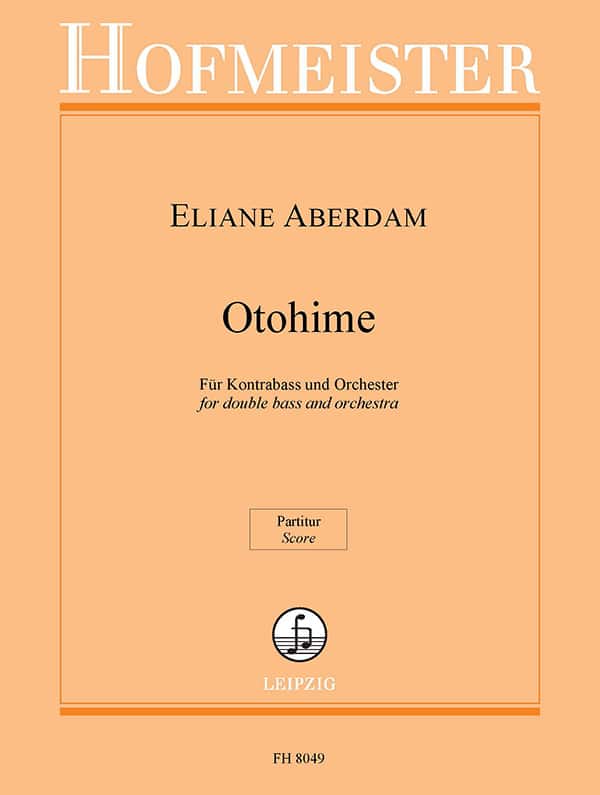
Aberdam: Otohime
- Composer: Elaine Aberdam
- Publisher: Friedrich Hofmeister Musikverlag
Choose options
Otohime is based on a Japanese folk tale about a young fisherman. One day he catches a fish. However, the fish persuades the fisherman to release it, to let it go, for it is Otohime, the Princess of the Sea. She promises to take him to her beautiful palace beneath the sea. Urashima Taro seemingly remains there for three days, while in reality three hundred years pass. Upon parting, Otohime gives him a box called Tamatebako and warns him that it must remain near him at all times. When Urashima Taro returns to Mizu-No-Ye, he does not recognize the village and sees his parents' grave in the cemetery. He is in despair and decides to open the box. But Tamatebako was the spell that kept Urashima Taro young, and when he opens it, he becomes a 300-year-old man. His hair turns white, his teeth fall out, he becomes an old man and collapses on the ground.
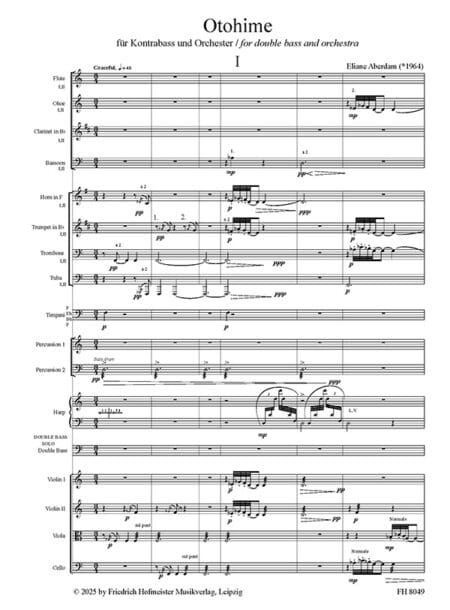
The first movement, "Mizu-no-ye," is about the sea, and with four 32nd-note motifs it reflects the tiny movements of the fish. It traces the smallest sparkles and water droplets with two-note pizzicati and ends with Urashima and Otohime's dive into the underwater palace.
The second movement, "Otohime," depicts life in the palace, and the main theme returns three times (three days, three hundred years). It is slow and opulent, harmonically rich and ceremonial.
After a brief transition representing Urashima's resurfacing, the third movement, "Tamatebako," breaks into rapid movements and dramatic chords intended to embody Urashima's return, his confusion, the rapid beating of his heart, and simultaneously the swiftness with which the years passed beneath the sea.
The double bass is the perfect instrument to symbolize the depth of the sea, the length of time, and the tragedy of the story. Woven into the composition are quotations from Francesco Geminiani's Concerto XII "La Folia," Concerto IV, and Concerto VI.