
BARENREITER - 345062
Seitz: Concerto in G major, op. 13
Composer: Friedrich Seitz
Publisher: Bärenreiter
Instrumentation: Violin
Binding: Stapled
Dimensions: 11.8 in x 9.1 in
Pages: 20
Quantity:
Pickup available at Juilliard Store
Usually ready in 4 hours
Seitz: Concerto in G major, op. 13
Juilliard Store
Pickup available, usually ready in 4 hours
144 West 66th Street
New York NY 10023
United States
Choose options
Quantity:
Pickup available at Juilliard Store
Usually ready in 4 hours
Seitz: Concerto in G major, op. 13
Juilliard Store
Pickup available, usually ready in 4 hours
144 West 66th Street
New York NY 10023
United States
Quantity:
Pickup available at Juilliard Store
Usually ready in 4 hours
Seitz: Concerto in G major, op. 13
Juilliard Store
Pickup available, usually ready in 4 hours
144 West 66th Street
New York NY 10023
United States
Editor: Sassmannshaus, Kurt
Orchestral scoring : V-solo/Orch
Product format: piano reduction, part(s)
Binding: Stapled
Pages / Format: 43413 - 30,0 x 23,0 cm
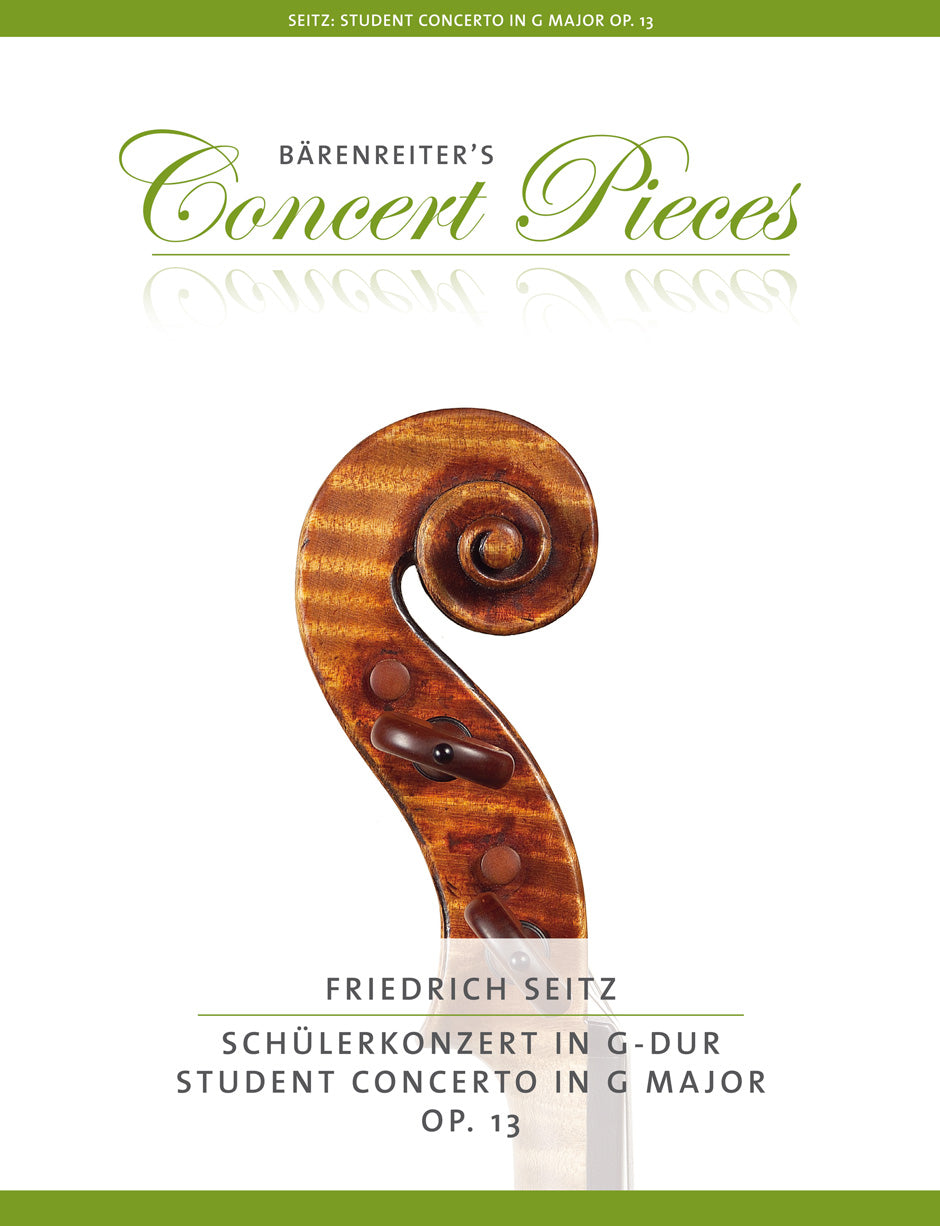
When the young Marlene Dietrich took violin lessons in Dessau from Friedrich Seitz (1848-1918), did she have this concerto in her repertoire? Whatever the case, her career, as we all know, took off on a different slant. But the Student Concerto in G major, op. 13, advanced to become one of the most popular and effective recital pieces for young violinists en route to the great concert stage.
Friedrich Seitz was a concertmaster and violin teacher, first in Magdeburg and later, from 1884, in Dessau. He published his op. 13 concerto in 1893. It is laid out in the conventional three movements: a charming Allegro non troppo poised between concert and salon music, a sentimental Adagio in a minor key, and a merry Rondo in 6/8 metre as a finale. Like almost every work by this passionate music educator, it stands in the facile e brillant tradition, achieving maximum impact with minimum technical demands while adopting the posture of a virtuoso concerto. A solid command of the first position is sufficient for its performance, with good left- and right-hand coordination required in the fast passages. The learner's technical skills are honed on simple double stops and détaché, legato and elementary spiccato bowing. Typical formal sections, such as a cadenza in the opening movement, and lovely, memorable melodies, call for an imaginative delivery: students learn how much fun it can be to play 'virtuoso' music!
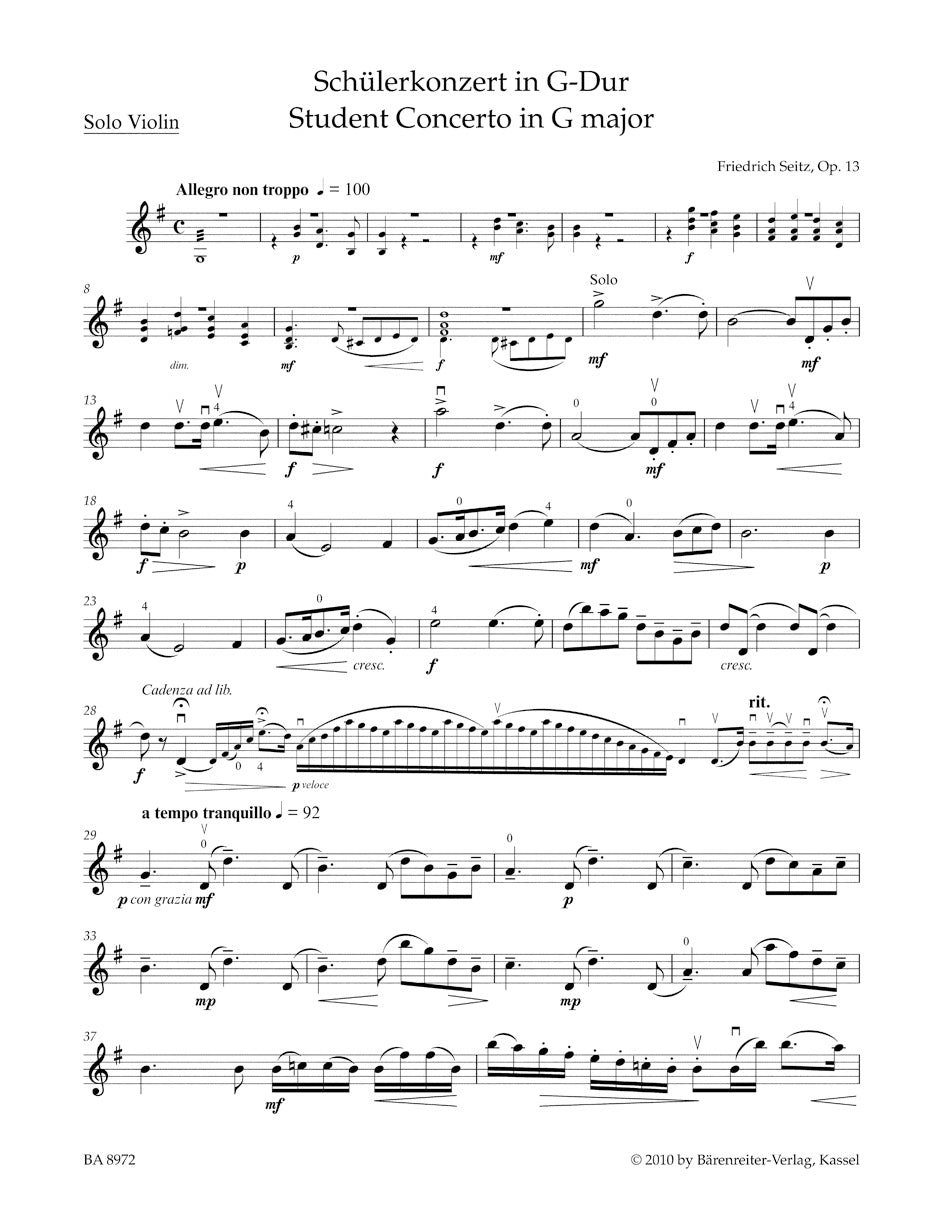
This edition appears in the Bärenreiter's Concert Pieces series, which includes popular concertos and concert pieces for young violinists. The editor is the internationally acclaimed violin teacher Kurt Sassmannshaus, who has added fingering and bowing to the solo part and explains the technical requirements in a short preface.
- One of the most popular and effective student concertos of the 19th century
- Written entirely in first position
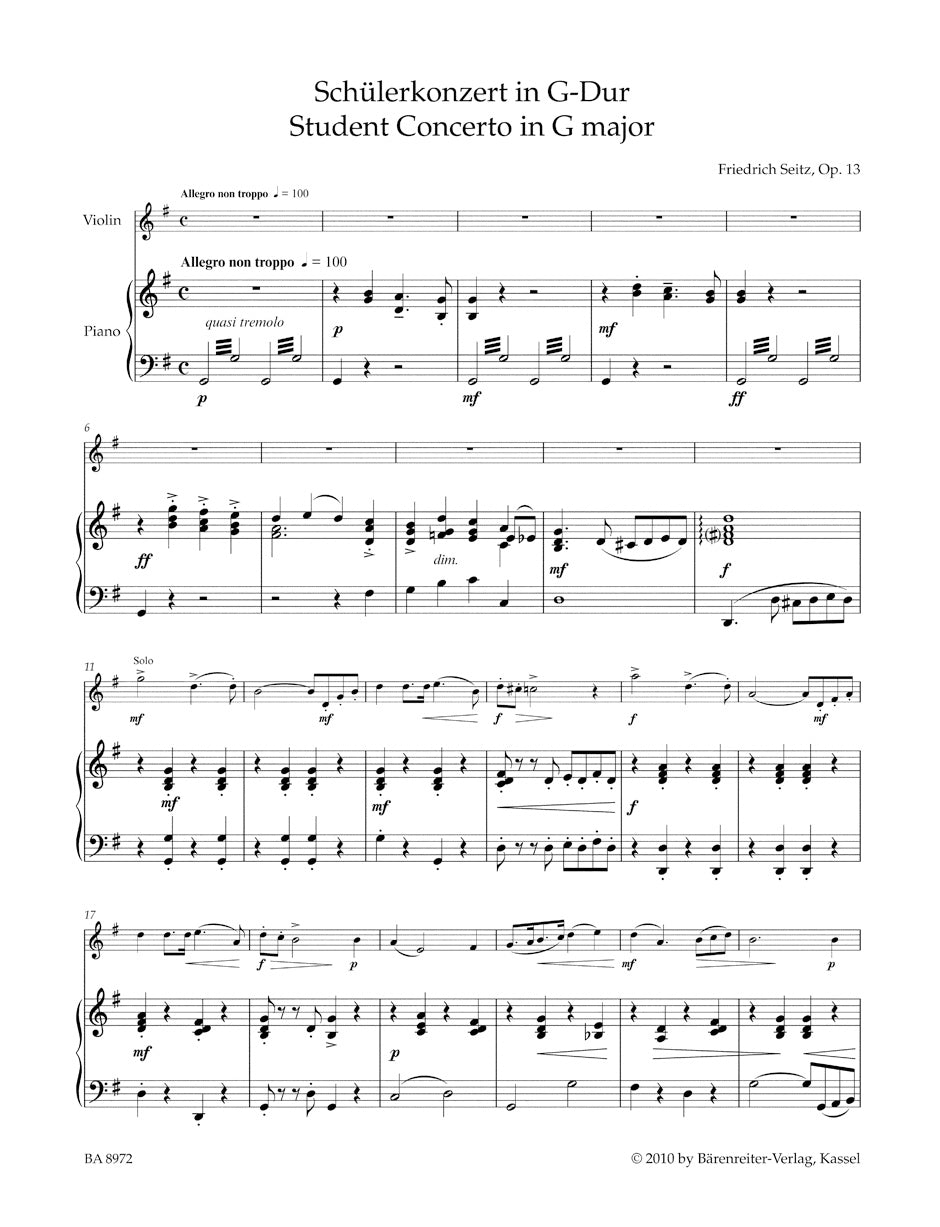
- Includes a solo part and a score with the piano accompaniment
- Short preface in German and English with information on technical requirements
Friedrich Seitz was a concertmaster and violin teacher, first in Magdeburg and later, from 1884, in Dessau. He published his op. 13 concerto in 1893. It is laid out in the conventional three movements: a charming Allegro non troppo poised between concert and salon music, a sentimental Adagio in a minor key, and a merry Rondo in 6/8 metre as a finale. Like almost every work by this passionate music educator, it stands in the facile e brillant tradition, achieving maximum impact with minimum technical demands while adopting the posture of a virtuoso concerto. A solid command of the first position is sufficient for its performance, with good left- and right-hand coordination required in the fast passages. The learner's technical skills are honed on simple double stops and détaché, legato and elementary spiccato bowing. Typical formal sections, such as a cadenza in the opening movement, and lovely, memorable melodies, call for an imaginative delivery: students learn how much fun it can be to play 'virtuoso' music!
This edition appears in the Bärenreiter's Concert Pieces series, which includes popular concertos and concert pieces for young violinists. The editor is the internationally acclaimed violin teacher Kurt Sassmannshaus, who has added fingering and bowing to the solo part and explains the technical requirements in a short preface.
- One of the most popular and effective student concertos of the 19th century
- Written entirely in first position
- Includes a solo part and a score with the piano accompaniment
- Short preface in German and English with information on technical requirements